315 - Born Small, Seeing Big Differences: Evaluating Retinopathy of Prematurity Outcomes in IUGR vs. AGA Infants <29 Weeks
Monday, April 27, 2026
8:00am - 10:00am ET
Publication Number: 4309.315
Lena Rammouni, Advocate Children's Hospital - Oak Lawn, Chicago, IL, United States; Alexandra Wilson, Advocate Children's Hospital - Oak Lawn, Northfield, IL, United States
Pediatric Resident Advocate Children's Hospital - Oak Lawn Chicago, Illinois, United States
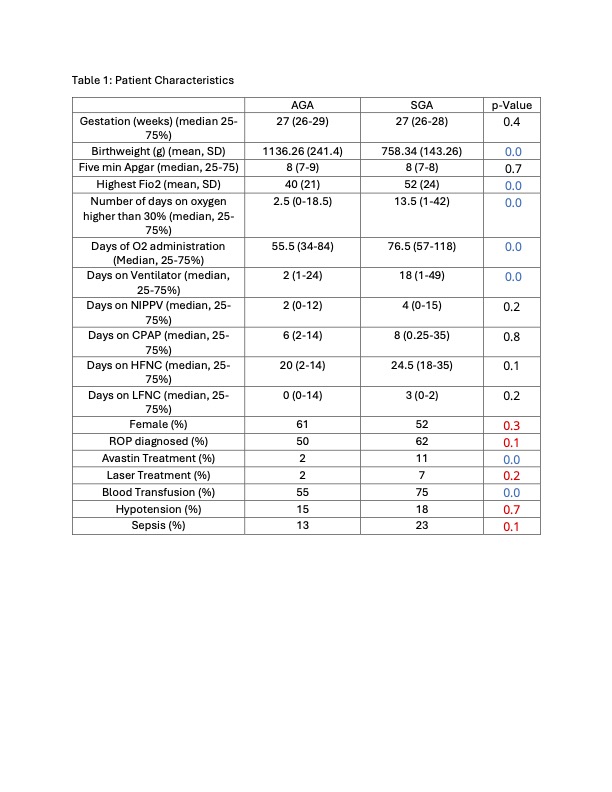
Background: Retinopathy of prematurity (ROP) remains a major cause of visual impairment in preterm infants. Intrauterine growth restricted (IUGR) infants are often considered at higher risk, but whether this is due to growth restriction or illness severity is unclear. This study compares IUGR and appropriate-for-gestational-age (AGA) infants to identify clinical factors associated with ROP. Objective: To determine whether intrauterine growth restriction (IUGR) is associated with increased incidence of retinopathy of prematurity (ROP) in infants born at < 29 weeks gestational age. Design/Methods: A retrospective cohort of preterm infants admitted to a tertiary NICU was analyzed. Demographic and clinical characteristics were compared between IUGR and AGA groups. Logistic regression assessed associations between ROP and key variables, including IUGR status, resuscitation intensity, blood transfusion, and respiratory support. Results: IUGR infants had significantly lower birthweight (758 g vs. 1136 g, p < 0.001), higher FiO₂ exposure (52% vs. 40%, p < 0.001), and more ventilator days (median 18 vs. 2, p < 0.001). Blood transfusion was more frequent in IUGR infants (75% vs. 55%, p < 0.001). ROP occurred in 62% of IUGR vs. 50% of AGA infants (p = 0.1). Logistic regression indicated ventilator use (OR ≈ 2.4, 95% CI: 0.9-6.1, p ≈ 0.08) and intensive resuscitation (OR ≈ 1.7, p ≈ 0.07) were associated with increased odds of ROP, while IUGR status and blood transfusion were not independent predictors. Model pseudo R² = 0.216, overall p < 0.001.
Conclusion(s): IUGR infants exhibit greater illness severity, reflected by prolonged oxygen exposure and ventilator support, which may explain their higher ROP incidence. Illness severity, rather than IUGR status alone, appears to drive ROP risk. These findings underscore the need for targeted monitoring and interventions in high-risk infants.