462 - What Do Teachers and Allied Health Professionals Know About the Educational Consequences of Prematurity?
Monday, April 27, 2026
8:00am - 10:00am ET
Publication Number: 4453.462
Genevieve Guyol, Boston University School of Medicine, Boston, MA, United States; Aimee ELIZABETH. Ketchum, STEM Starts Now, LITITZ, PA, United States; Stacey Y. Ruiz, Boston Medical Center, Falls Church, VA, United States; Jonathan S. Litt, Stanford University School of Medicine, Palo Alto, CA, United States; Margaret Parker, UMass Chan School of Medicine, Worcester, MA, United States
Assistant Professor Boston University School of Medicine Boston, Massachusetts, United States
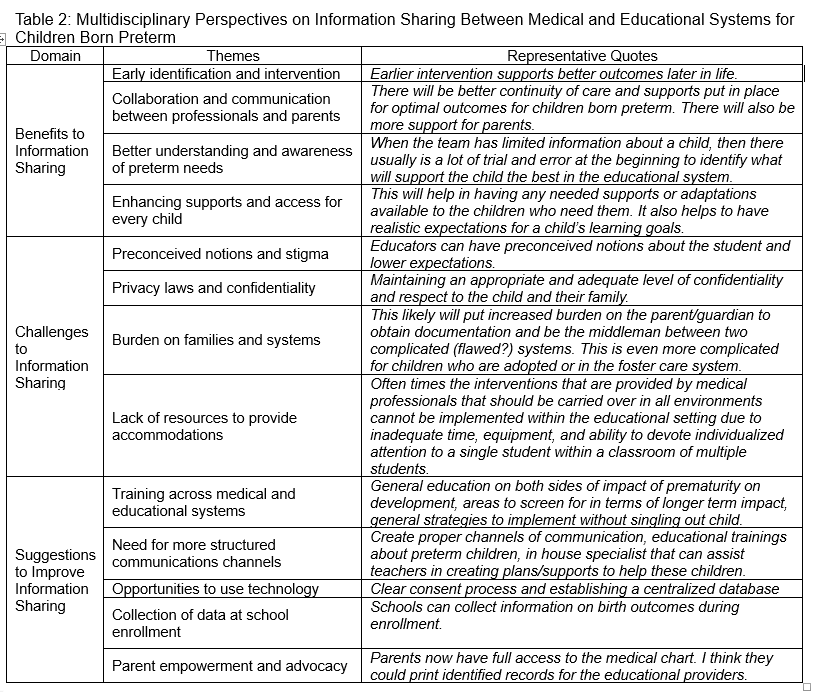
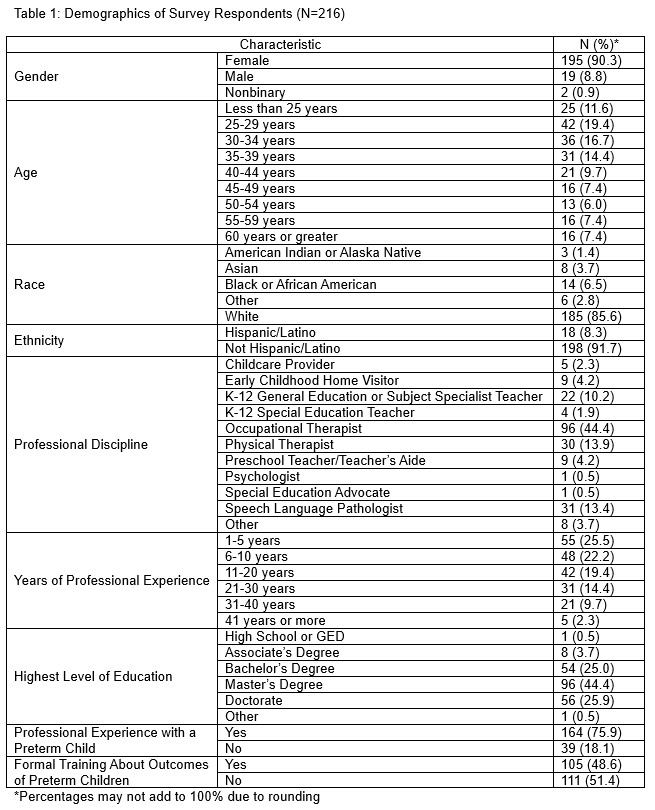
Background: Teachers and allied health professionals who care for preterm children after NICU discharge receive varying education about well-documented associations between preterm birth and adverse educational outcomes. To optimize tailored supports for preterm children, it is important to understand what teachers and allied health professionals know about the educational consequences of prematurity. Objective: Among teachers and allied health professionals, we 1) Examined knowledge of the educational consequences of prematurity, 2) Investigated self-efficacy in delivering services to preterm children, and 3) Solicited suggestions for improving information sharing about prematurity between the medical and educational systems. Design/Methods: We administered a REDCap survey to a convenience sample of teachers and allied health professionals. We recruited participants via electronic platforms and at professional conferences. We assessed knowledge of preterm birth using the Preterm Birth Knowledge Scale and self-efficacy delivering services to preterm children using a previously published measure. We calculated descriptive statistics overall and by discipline. We solicited free text responses on benefits, challenges, and suggestions to improve information sharing and used qualitative content analysis to analyze these responses. We obtained IRB approval. Results: We surveyed 216 respondents from 33 states in the US and 4 countries outside of the US (Table 1). On average, respondents answered 22 of the 33 Preterm Birth Knowledge Scale questions correctly with some variation among disciplines. Prior formal training on the outcomes of preterm children varied according to discipline. There was variation in perceptions of being adequately equipped to support preterm learning needs. Providers across disciplines desired to learn about strategies for supporting preterm children (Figure 1). Benefits to information sharing between the medical and educational systems included improved collaboration and supports. Challenges included stigma, privacy, and burden on families and systems. Suggestions for improving information sharing included training, structured communication, leveraging technology, and parent empowerment (Table 2).
Conclusion(s): Teachers and allied health professionals had poor knowledge of the educational consequences of prematurity and want to know how to support preterm children. Interventions should integrate education about prematurity into professional training and improve information sharing between the medical and educational systems.
Table 1: Demographics of Survey Respondents (N=216)
Figure 1: Knowledge of Preterm Birth and Self-Efficacy in Caring for Preterm Children by Discipline (N=216)
Table 2: Multidisciplinary Perspectives on Information Sharing Between Medical and Educational Systems for Children Born Preterm









.png)