








Quality Improvement/Patient Safety
Session: Quality Improvement/Patient Safety 5
Emily Vara, DO (she/her/hers)
Medical University of South Carolina College of Medicine
Charleston, South Carolina, United States
.jpg) Sociodemographic features of screened patients at the three centers.
Sociodemographic features of screened patients at the three centers. .jpg) A randomly selected sample of 10 patients per month at each site were assessed for depression screening for a total of 30 patients per month across all 3 sites. Compiled data on percent of patients screened for depression (Figure 1A), patients with positive depression screen (Figure 1B), distribution of severity of depression (Figure 1C), diseases with positive depression screens (Figure 1D), and percent of patients with appropriate response to depression screening according their respective site's process map (Figure 1E) are depicted in pie charts.
A randomly selected sample of 10 patients per month at each site were assessed for depression screening for a total of 30 patients per month across all 3 sites. Compiled data on percent of patients screened for depression (Figure 1A), patients with positive depression screen (Figure 1B), distribution of severity of depression (Figure 1C), diseases with positive depression screens (Figure 1D), and percent of patients with appropriate response to depression screening according their respective site's process map (Figure 1E) are depicted in pie charts.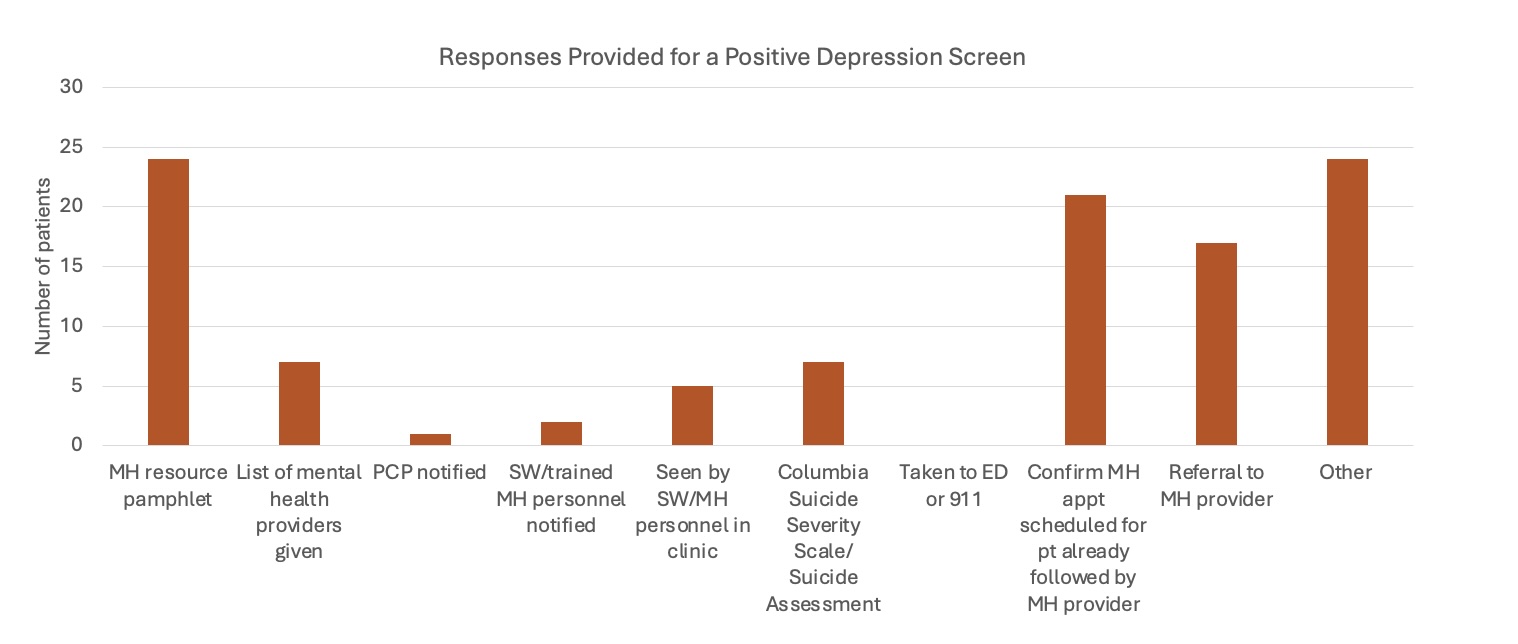 Distribution of Responses to Positive Depression Screening. Each site developed a process map for responding to mild, moderate, and severe depression based on screening. A randomly selected sample of 10 patients per month at each site were assessed for depression screening. 90% of sampled patients had a positive depression screen. 91% of patients with positive screens were addressed with at least one of the responses noted in the bar graph. Other responses included situational stressors reviewed with patient and to return to clinic if concerns arise (14 of 24), PCP arranging local therapy referral (1 of 24), and Corresponded in EMR with Behavioral/Mental Health provider (1 of 24).