490 - Maternal Media Use and Home Environment as Drivers of Toddler Background TV Exposure
Monday, April 27, 2026
8:00am - 10:00am ET
Publication Number: 4481.490
Sarbik Saha, University of Colorado Anschutz, Boston, MA, United States; Natasha Cabrera, University of Maryland-College Park, College Park, MD, United States; Haley Ringwood, University of Colorado School of Medicine, Denver, CO, United States; Estefania Miramontes Valdes, University of Colorado School of Medicine, Philadelphia, PA, United States; Andrea M. Jimenez-Zambrano, University of Colorado - Aurora, CO, Aurora, CO, United States; Darcy A.. Thompson, University of Colorado Anschutz School of Medicine, Aurora, CO, United States
Research Intern University of Colorado Anschutz Boston, Massachusetts, United States
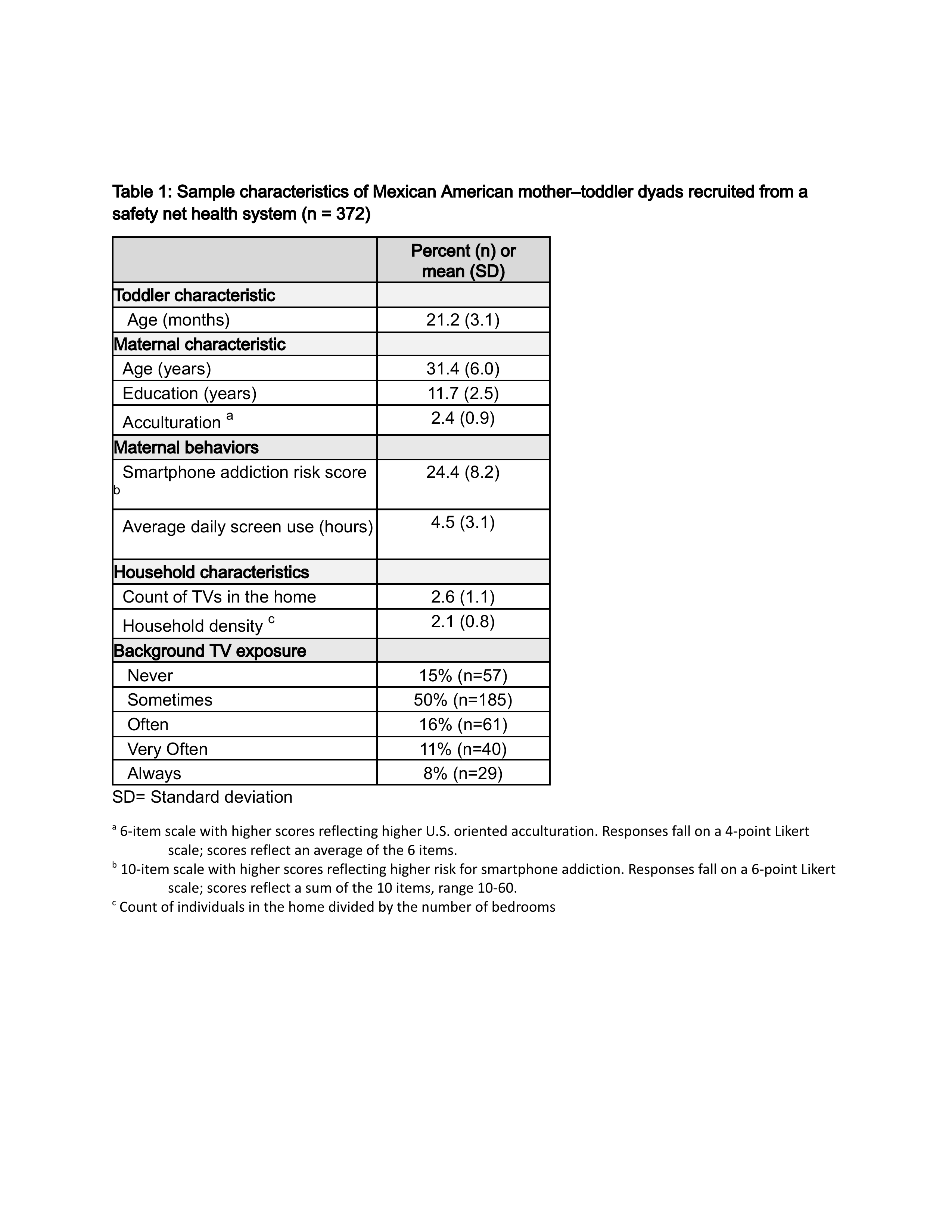
Background: Background television (TV), defined as live TV near a child while the child is engaged in other activities, has been associated with lower-quality mother-child interactions, poorer child sustained attention, and overall child lower executive functioning. Limited research, however, has examined correlates of background TV exposure among Mexican American families with toddlers, who experience higher overall screen exposure and are likely to live in high density households. Objective: To evaluate whether maternal screen use, household context, and demographic factors are associated with toddler background TV exposure in a cohort of Mexican American families. Design/Methods: Data were used from a cross-sectional study of Mexican American families with toddlers (15-26 months old) recruited from a safety-net health system. Background TV exposure was measured as frequency the TV is on near the child when playing (maternally-reported). Maternal screen behaviors (screen use duration, smartphone addiction risk), household context (number of TVs, household density), and demographic characteristics (maternal age, education, acculturation, child age) were measured using survey tools. Hierarchical linear regression was used to evaluate whether maternal screen use, household context, and demographic factors were associated with frequency of toddler background TV exposure. Results: Sample characteristics are shown in Table 1. Mothers were on average 31 years old (SD=6.1), with a mean of 11.7 years of education (SD=2.5). Mean toddler age was 21 months (SD=3.1), and families had an average of 2.6 televisions and 2.1 persons per bedroom. Hierarchical linear regression results are presented in Table 2. No demographic characteristic was associated with toddler background TV. Number of TVs in the home was significantly associated with toddler background TV, adjusted for demographic variables (ϐ=0.15, 95% CI: 0.04-0.25). Both maternal average daily hours of screen use and smartphone addiction risk were significantly associated with toddler background TV exposure, adjusted for demographic and household factors (β=0.05, 95% CI: 0.01-0.09 and β=0.02, 95% CI: 0.00-0.03, respectively).
Conclusion(s): Household factors and maternal media behaviors, but not demographic characteristics, were associated with increased toddler background TV exposure. These findings suggest that addressing parent screen behaviors and the home media setting may reduce young children's background screen exposure.
Table 1: Sample characteristics of Mexican American mother-toddler dyads recruited from a safety net health system (n = 372) SD= Standard deviation a 6-item scale with higher scores reflecting higher U.S. oriented acculturation. Responses fall on a 4-point Likert scale; scores reflect an average of the 6 items. b 10-item scale with higher scores reflecting higher risk for smartphone addiction. Responses fall on a 6-point Likert scale; scores reflect a sum of the 10 items, range 10-60. c Count of individuals in the home divided by the number of bedrooms
Table 2: Results of hierarchical linear regression analysis evaluating associations between maternal screen use, household context, and demographic factors with frequency of toddler background TV exposure. (n=372)










 SD= Standard deviation
 .png)
