686 - Efficacy of Ondansetron in Pediatric Gastroenteritis: A Systematic Review and Meta-Analysis of Randomized Controlled Trials
Monday, April 27, 2026
8:00am - 10:00am ET
Publication Number: 4671.686
Zaid Bazbaz, An-Najah National University, Jerusalem, Yerushalayim, Israel; Basant Mahmoud, October 6 University, Faculty of Medicine, Sittah Uktubar, Al Jizah, Egypt; Hammad Rao, Shaheed Mohtarma Benazir Bhutto Medical college Lyari Karachi Pakistan, Karachi, Sindh, Pakistan; arsalan Ahmed, Liaquat university of medical health sciences, Karachi City Gpo, Sindh, Pakistan; Mohamed Sherif, Faculty of dentistry, King Salman International University: El-Tor, South Sinai, Egypt, Faqus, Ash Sharqiyah, Egypt; Nabahat -. Shafi, Dow University of Health Sciences, Karachi, Sindh, Pakistan; Dalia Atef Abouda, Faculty of medicine Alexandria University Egypt, Beheria, Abu Matamir, Al Buhayrah, Egypt; Christian Cortes, Universidad Autónoma de Nuevo León, Monterrey, Nuevo Leon, Mexico; Jiya Achu. Jebi, Tbilisi State Medical University, Emirates city, Ajman, United Arab Emirates; Ahmed Adel, Faculty of Medicine, Zagazig University, Zagazig, Ash Sharqiyah, Egypt
Graduate An-Najah National University Jerusalem, Yerushalayim, Israel
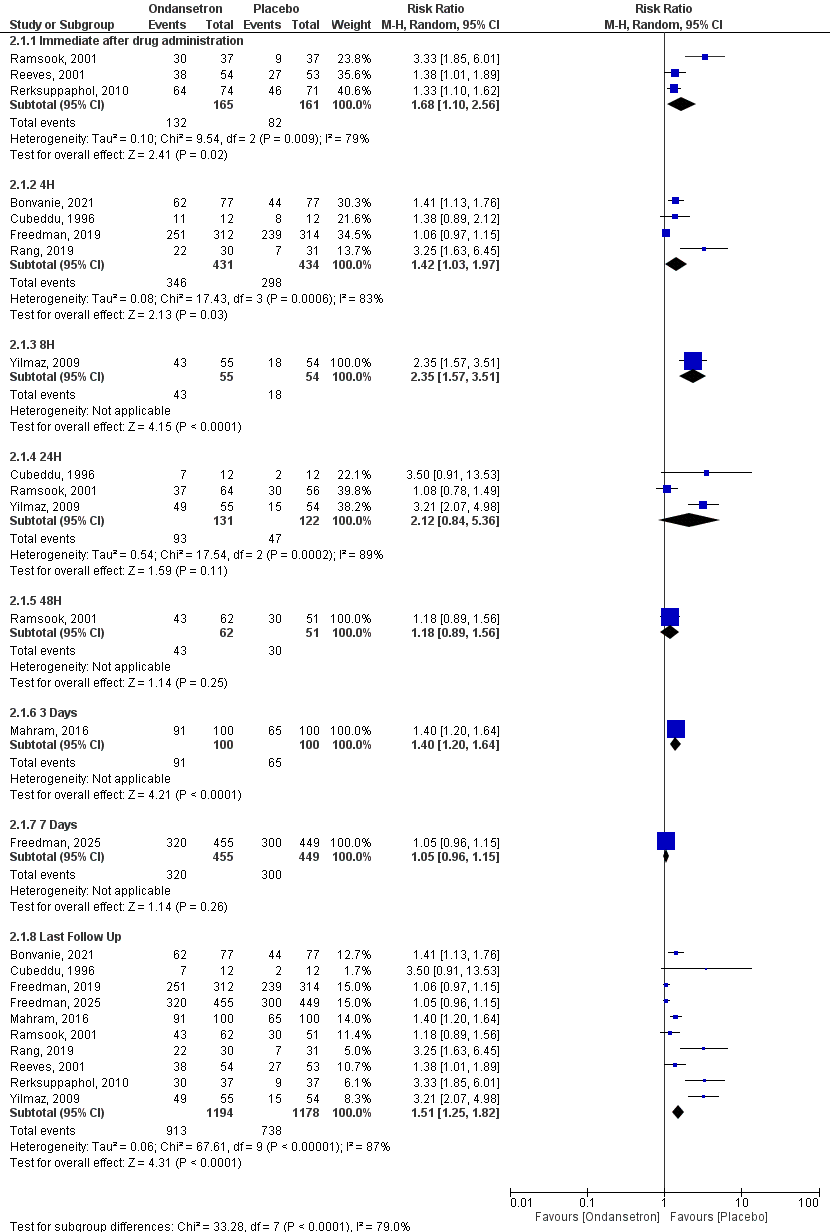
Background: Acute gastroenteritis is a major issue for pediatric health, resulting in countless emergency department (ED) visits. While primary treatment is oral rehydration therapy (ORT), persistent vomiting leads to treatment failure, the need for intravenous (IV) fluids, and subsequent hospital stays. Ondansetron, a 5-HT3 serotonin receptor blocker, is given to stop vomiting. Still, its effect in pediatric use needs thorough study. Objective: To evaluate the effect of ondansetron on vomiting duration and severity, the reduction in the need for IV fluid administration and hospitalization, and the incidence of adverse events in pediatric patients with acute gastroenteritis. Design/Methods: A systematic search was conducted across databases. The review was restricted to randomized controlled trials (RCTs) comparing ondansetron to a placebo in patients under 18 years with acute gastroenteritis. Risk of bias (RoB) was assessed using the Cochrane RoB 2 tool. Data were synthesized using Cochrane's Revman, a random-effects model was applied. Results are reported with 95% confidence intervals (CI). Results: Our meta-analysis of twelve RCTs (n=2,883 pediatric patients) with a low aggregate RoB, demonstrated compelling short-term efficacy. Ondansetron administration significantly increased the likelihood of emesis cessation immediately post-treatment compared to placebo (Risk Ratio [RR] 1.68; 95% CI 1.10-2.56; p=0.009) and on 4-hour follow-up (RR 1.42; 95% CI 1.03-1.97; p=0.0006) and on 24-hour (RR 2.12; 95% CI 0.84-5.36; p=0.0002). This rapid effect translated into meaningful clinical outcomes: it reduced the risk of initial ORT failure (RR 0.28; 95% CI 0.08-1.00; p=0.05) and substantially decreased the requirement for IV fluid administration (RR 0.45; 95% CI 0.22-0.90; p=0.03). However, analysis of long-term outcomes revealed no statistically significant difference between the intervention and control groups regarding the risk of hospitalization at 3-day, 7-day, or final follow-up time points.
Conclusion(s): Ondansetron is effective for the acute phase of pediatric gastroenteritis, by rapidly controlling vomiting and so facilitating oral rehydration. Despite immediate benefit, our findings indicate that the drug does not significantly alter the overall risk of subsequent hospitalization.
(Figure 1): Forest plot of the effect of Ondansetron on Cessation of vomiting, based on the follow-up time.