








Emergency Medicine
Session: Emergency Medicine 6
.jpg "Jacky D. Lin photo")
Jacky D. Lin
Medical Student
Renaissance School of Medicine at Stony Brook University
Jericho, New York, United States
.png) All assessment tools were completed regardless of randomization. Three anxiety assessment tools (FLACC, FPS, and VAS) related to the child were completed pre-procedurally and post-procedurally. Caregiver anxiety was evaluated using VAS pre-procedurally and post-procedurally, and an initial STAI. Additional assessments for demographics and satisfaction were also completed pre-procedure and post-procedure respectively.
All assessment tools were completed regardless of randomization. Three anxiety assessment tools (FLACC, FPS, and VAS) related to the child were completed pre-procedurally and post-procedurally. Caregiver anxiety was evaluated using VAS pre-procedurally and post-procedurally, and an initial STAI. Additional assessments for demographics and satisfaction were also completed pre-procedure and post-procedure respectively..png) Patient demographics were evaluated prior to randomization. Analysis of gender, age, prior ED visits, and prior needle procedures indicates successful randomization and a non-significant difference between groups. Age analysis was assessed by an unpaired two-tailed t-test (p-values > 0.05). Gender distribution, prior ED visits, and prior needle procedures analyses were assessed by chi-squared test (p-values > 0.05).
Patient demographics were evaluated prior to randomization. Analysis of gender, age, prior ED visits, and prior needle procedures indicates successful randomization and a non-significant difference between groups. Age analysis was assessed by an unpaired two-tailed t-test (p-values > 0.05). Gender distribution, prior ED visits, and prior needle procedures analyses were assessed by chi-squared test (p-values > 0.05).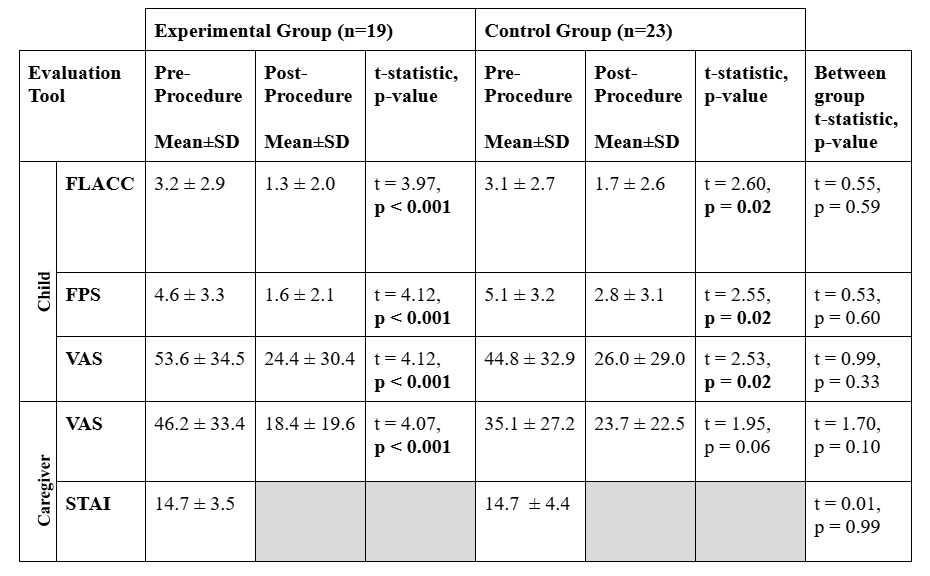 Caption: Mean anxiety scores across all evaluation tools in both the experimental and control group were reduced for the patient post-procedurally. Intra-group analysis was assessed using a paired two-tail t-test; inter-group analysis was assessed by an unpaired two-tailed t-test. p-values < 0.05 were considered statistically significant and are highlighted in bold.