329 - Are Women Taking the Podium? Gender representation amongst speakers at neonatology conferences.
Monday, April 27, 2026
8:00am - 10:00am ET
Publication Number: 4323.329
Kelly Walter, University of Arizona College of Medicine - Phoenix, Phoenix, AZ, United States; Hannah Zupancic, Women & Infants Hospital of Rhode Island, Providence, RI, United States; Luna Hurtado-A, Beth Israel Deaconess Medical Center, Brighton, MA, United States; Kim Ruiz-Arellanos, Beth Israel Deaconess Medical Center, Boston, MA, United States; Grace E. Fuller, University of North Carolina at Chapel Hill School of Medicine, Chapel Hill, NC, United States; Sarah Kunz, Boston Children's Hospital, Boston, MA, United States; Alejandra Barrero-Castillero, Beth Israel Deaconess Medical Center/ Harvard Medical School, Brookline, MA, United States; Emily Whitesel, Beth Israel Deaconess Medical Center, Boston, MA, United States; John Zupancic, Harvard Medical School, Boston, MA, United States; Susanne Hay, Harvard Medical School, Boston, MA, United States
Instructor Harvard Medical School Boston, Massachusetts, United States
Background: Gender inequity remains pervasive in the modern workplace, including in neonatology, where, despite being the majority entering the field, women earn less and less-frequently hold leadership positions. Evaluation of further gender-specific data can help assess progress and identify areas for improvement. Objective: To describe gender representation amongst speakers at major United States Neonatology Conferences over the past 15 years. Design/Methods: Conference proceedings from eight major annual US Neonatology Conferences between 2010 and 2024 were reviewed. Given the infeasibility of asking for gold-standard, self-identified gender, we used a previously-validated, international database (WGND 2.0, Harvard Dataverse) to calculate the correlation between a given name and likely gender. A probability of 0.55 was used for imputation, and personal knowledge or media search was used to attempt assignments in cases where gender remained unknown. Differences in gender distributions were evaluated in the contexts of conference year and type of speaking role, through logistic regression and chi-square testing. Results: Data from 94 (78%) of the 120 anticipated annual conferences held within this timeframe were available. A total of 4,975 speakers were included, of whom 1,922 (39%) were designated by the database as female, 3,038 (61%) male, and 15 ( < 1%) indeterminate. The proportion of female speakers demonstrated a significant increase over time (p < 0.01), rising from 20% in 2010 to 54% in 2024 (Figure 1). There were significant differences in gender balances when considered by type of speaking role (p < 0.01), with women having near equal representation in panels (48%), workshops (48%), and administration (46%); but being less likely to hold honoree (19%), master of ceremonies (35%), or major presenter (37%) roles. Notably, women were found to be gaining ground across almost all speaking roles over time, with the exception of administrative roles.
Conclusion(s): Opportunities for women to deliver invited talks at U.S. neonatology conferences are becoming more frequent, from underrepresentation in 2010 to nearly proportional representation in most categories today. However, differences may remain in the type or prominence of invitations. The trend accompanies a shifting gender balance in the field. This analysis is limited in its representation of gender as a simple dichotomy, but is a starting point for further exploration and discussion. Optimistically, the voice given to women as thought leaders in conferences could lead to improvement in other areas of gender inequity in the field.
Figure 1 Proportion of female versus male conference speakers over time.









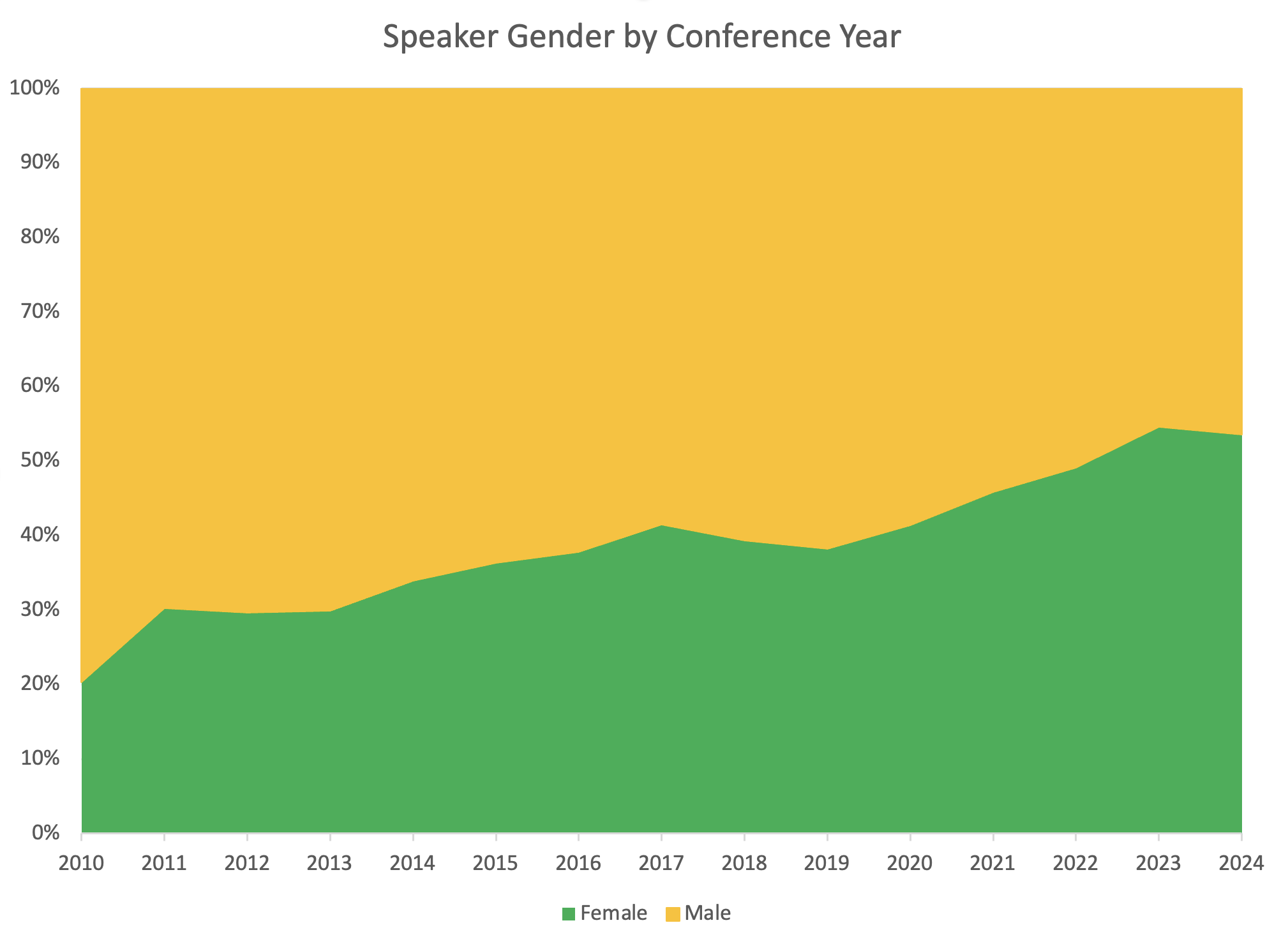 Proportion of female versus male conference speakers over time.