113 - Beyond the Bundle: An Interdisciplinary Quality Improvement Initiative for NICU CLABSI Prevention
Monday, April 27, 2026
8:00am - 10:00am ET
Publication Number: 4111.113
Rebecca Rose, Indiana University/Riley Hospital for Children at IU Health, Indianapolis, IN, United States; Laura Blazier, Riley Hospital for Children at Indiana University Health, Indianapolis, IN, United States
Associate Professor of Clinical Pediatrics Indiana University/Riley Hospital for Children at IU Health Indianapolis, Indiana, United States
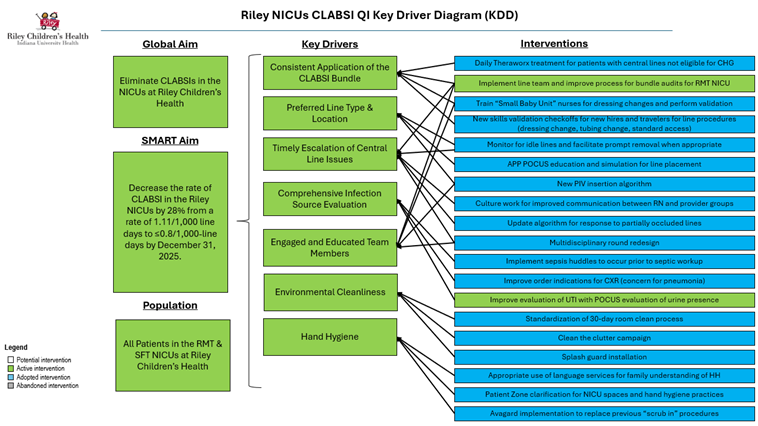
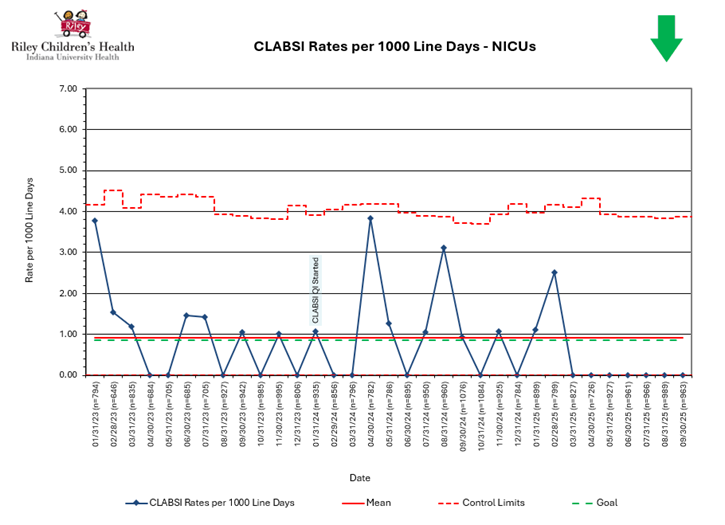
Background: Central line-associated bloodstream infections (CLABSIs) pose significant risks to neonatal patients, contributing to mortality, prolonged hospitalization, and increased healthcare costs. In response to increasing CLABSI rates, our NICUs launched a collaborative quality improvement (QI) initiative in 2024 to reduce CLABSI rates and enhance patient safety. Objective: To achieve a 28% reduction in CLABSI rates from a baseline of 1.11/1,000-line days with a targeted rate of ≤0.8/1,000-line days by December 31, 2025. Design/Methods: This study utilized standard QI methodology. An interdisciplinary team was established to focus on CLABSI prevention. A thorough review of previous CLABSI cases was conducted and current clinical practice standards were reviewed with themes and opportunities identified. A key driver diagram guided the initiative, identifying areas for intervention (Figure 1). Targeted strategies included consistent adherence to the CLABSI maintenance bundle, optimization of line type and site selection, timely escalation of central line concerns, comprehensive infection source evaluation, engagement and education team members, environmental cleanliness, and consistently reliable hand hygiene performance. Results: Since implementation, the NICU has demonstrated continuous improvement in CLABSI rates, decreasing from 1.11/1,000-line days in 2023 to a current YTD rate of 0.44/1,000 line-days in 2025 demonstrating a 60% reduction (Figure 2). The standardized infection ratio (SIR) reached 0.24 indicating statistically significant outcomes (p= .0019) outperforming national benchmarks.
Conclusion(s): A structured, interdisciplinary approach to CLABSI prevention, grounded in evidence-based practice, can drive meaningful, sustained reductions in CLABSI rates. This initiative highlights the importance of collaboration, targeted interventions, and a mindset of continuous improvement in advancing neonatal care excellence.