Resident Pediatric Physician Valley Children's Healthcare Madera, California, United States
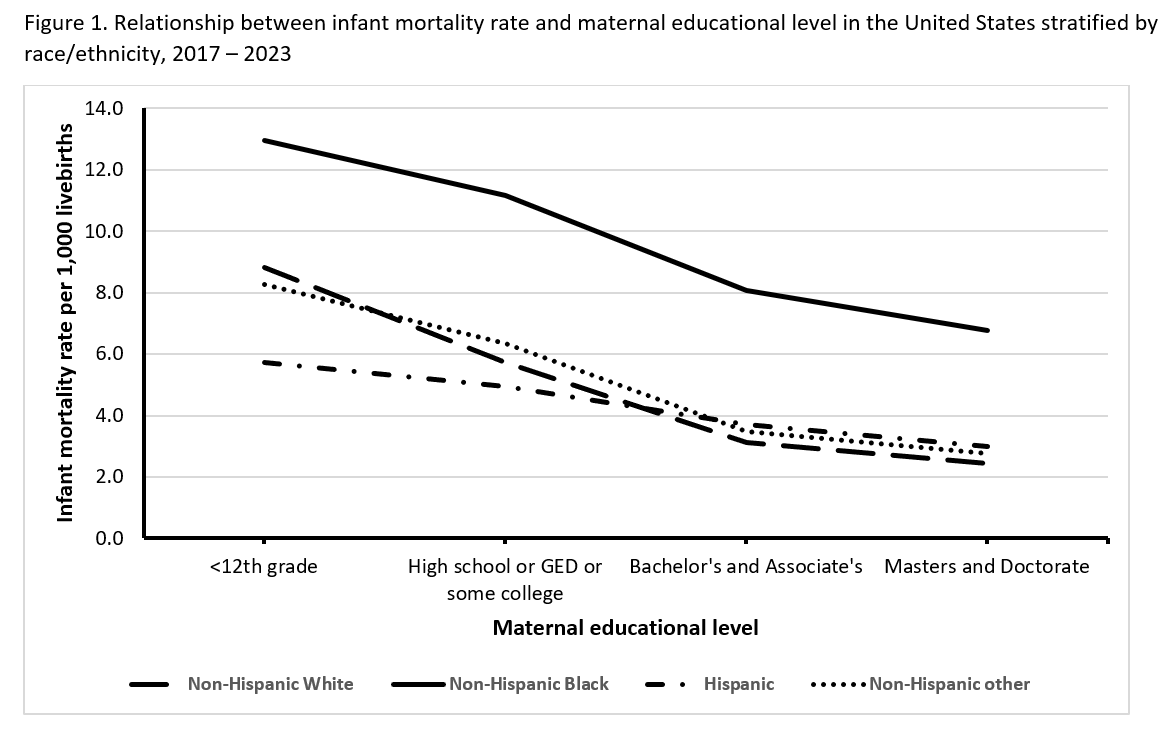
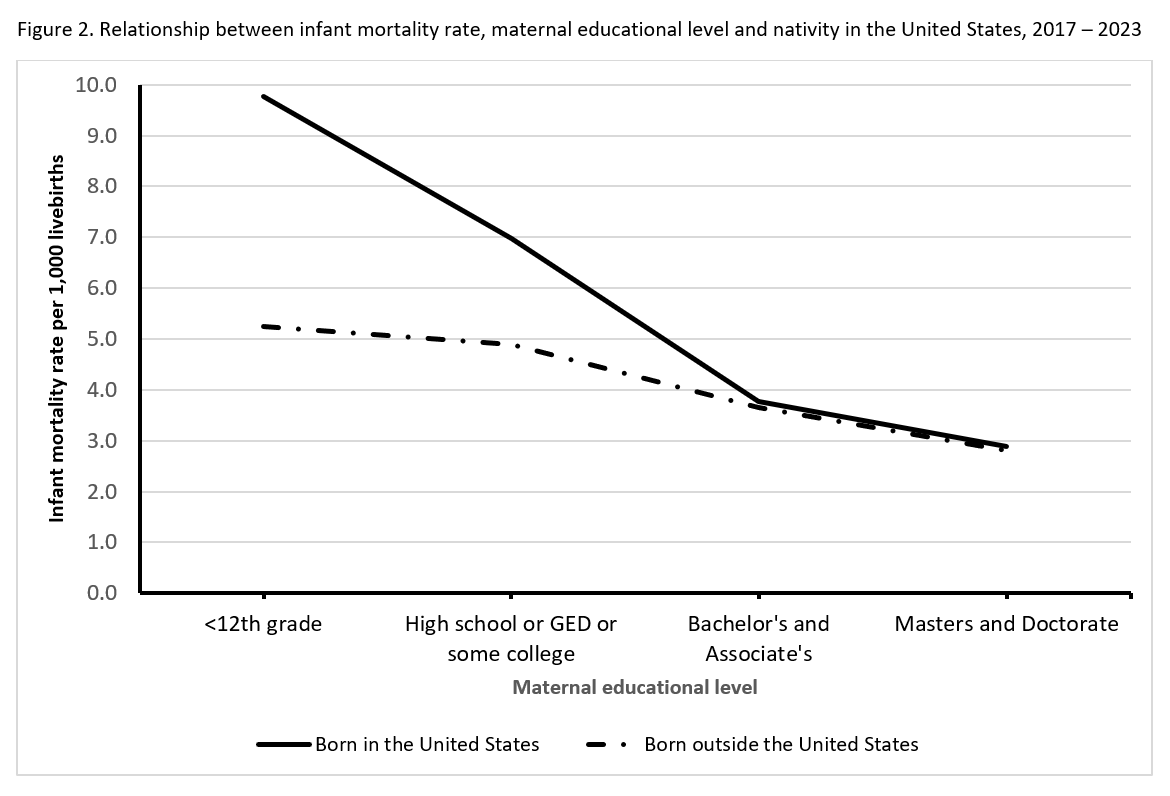
Background: Studies show that higher maternal education is linked to lower infant mortality (IMR) in the U.S. Interestingly, infants born to foreign-born mothers-who often have lower education levels-tend to have better outcomes than those born to U.S.-born mothers. While educational attainment has increased across all racial/ethnic groups since 2002, no population-based study since 2010 has examined how maternal nativity, education, and race/ethnicity intersect to affect IMR. Objective: To investigate the relationship between maternal race/ethnicity, educational attainment, and nativity on IMR in the US from 2017-2023. Design/Methods: In this retrospective study, we used data from the 2017-2023 the linked birth/infant death dataset from the CDC WONDER. Race was self-reported and categorized as non-Hispanic White (NHW), non-Hispanic Black (NHB), Hispanic, and non-Hispanic others (NHO). The highest maternal educational attainment was self-reported and categorized into four groups ( < 12th grade; high school, general educational development (GED), and some college; Bachelor's and Associate's degree; Masters/Doctorate). The exposures were maternal educational attainment and nativity (born in or outside the US) and the outcome was IMR, stratified by race/ethnicity. Records without race/ethnicity data were excluded. IMR was expressed per 1,000 live births. Mann-Whitney U test was used for pair-wise comparisons and P< 0.05 defined statistical significance. Results: For all racial/ethnic groups and regardless of maternal nativity, the IMR decreased significantly with increasing educational (Figures 1 and 2). Compared to US born mothers, the overall IMR was lower for mothers born outside the US (4.5 vs 5.9; P< 0.001) and among those without a Bachelor's degree. There was no significant difference among those with college or postgraduate degrees (Figure 2). Further, the IMR was significantly lower among foreign-born mothers for each racial/ethnic group and for each educational level compared to US born mothers (Table 1). For each educational level and regardless of maternal nativity, the IMR was higher for NHB infants (Figure 1 and Table 1).
Conclusion(s): IMR declined with higher maternal education, and foreign-born mothers had lower IMRs than US-born mothers across all educational levels and racial/ethnic groups. However, NHB had a disproportionately higher IMR at all maternal educational levels, regardless of nativity. The mechanism by which nativity and race/ethnicity influence the association between maternal education and IMR requires further study.
Table 1. Relationship between maternal educational attainment, nativity, and race/ethnicity on infant mortality rate in the United States, 2017-2023.
Figure 1. Relationship between infant mortality rate and maternal educational level in the United States stratified by race/ethnicity, 2017 - 2023
Figure 2. Relationship between infant mortality rate, maternal educational level and nativity in the United States, 2017 - 2023










.png)