312 - The Prevalence of Hypoallergenic Diet Use Among Ex-Premature Infants
Sunday, April 26, 2026
9:30am - 11:30am ET
Publication Number: 3301.312
Emma Adkins, Brigham and Women's Hospital, Brookline, MA, United States; Melissa A. Woythaler, Brigham and Women's Hospital, Boston, MA, United States; Victoria Martin, Harvard Medical School, Boston, MA, United States
Research Assistant Brigham and Women's Hospital Brookline, Massachusetts, United States
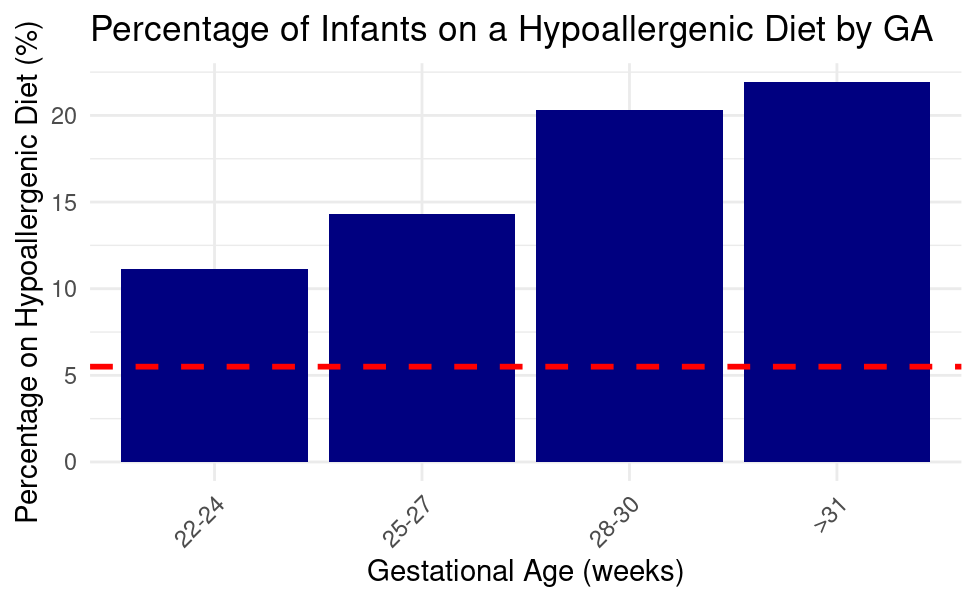
Background: Infants with medical conditions that limit tolerance of standard formulas or breast milk are commonly placed on a hypoallergenic (HA) diet. The primary clinical indication is suspected or confirmed cow's milk protein allergy (Osborn et al, 2018; Lee et al, 2024). Preterm infants may be particularly vulnerable to feeding intolerance due to immature gastrointestinal and immune systems, increasing the likelihood of HA formula use (Henderick et al, 2021). Allergen elimination strategies include maternal dietary modification or use of hydrolyzed or amino-acid-based formulas. Despite frequent feeding concerns in ex-premature infants, data describing the prevalence of HA formula use in this population is limited. Market estimates suggest that approximately 5.5% of all infant formulas sold are HA, providing a reference point for expected use in the general infant population. Objective: To quantify the prevalence of HA diet use and identify associated clinical predictors among ex-premature infants followed at the Center for Child Development (CCD) at Brigham and Women's Hospital. Design/Methods: A retrospective chart review was conducted for infants followed at the CCD between 1/1/23, and 12/31/24. Eligible infants were born at < 33 weeks gestation or < 1500g birth weight at >33 weeks gestation. Demographic and clinical variables including sex, maternal race, multiple gestation, gestational age, insurance type, as well as growth metrics and diet type at 7 days, 28 days, postmenstrual age 35 weeks, and at 1 and 4 months corrected age were collected. Chi-square tests compared infants on HA formula versus standard diet, and multivariable regression was used to evaluate predictors of HA formula use. Results: A total of 181 infants met inclusion criteria and had data to review. The HA prevalence in our sample was 19.3%, which is significantly higher than the 5.5% prevalence in the US population (Z=8.17, p< 0.001). Increasing gestational age was associated with a higher likelihood of HA formula use. Sex, gestational age, insurance type, and growth metrics were not significantly associated with HA diet. White race and infants receiving any donor milk at 28 days had a significantly higher likelihood of HA formula use (p=0.047). Maternal language approached significance.
Conclusion(s): Ex-premature infants born < 33 weeks gestation or < 1500 grams at birth demonstrate substantially higher use of HA formula compared with the general infant population. Further research is needed to clarify the drivers of HA diet use in this population and to evaluate its impact on growth and long-term developmental outcomes.
Percentage of Infants on a Hypoallergenic Diet by Gestational Age The dotted red line represents the market use of hypoallergenic formulas sold in the United States.









 The dotted red line represents the market use of hypoallergenic formulas sold in the United States.