








Neonatal Pulmonology
Session: Neonatal Pulmonology - Clinical Science 1: Bronchopulmonary Dysplasia I
Addilyn B. Smith, DO (she/her/hers)
Clinical Informatics Fellow
Cincinnati Children's Hospital Medical Center
Cincinnati, Ohio, United States
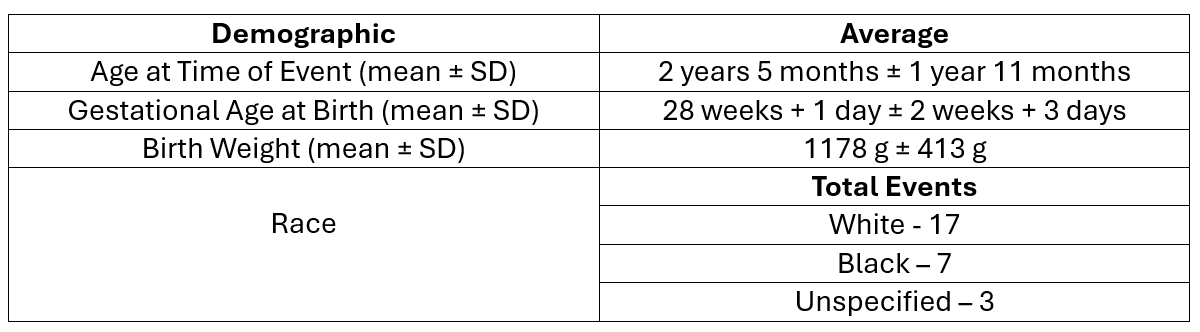 Among our sample of 26 code events in 18 patients, the average age at the time of emergent intervention was 2 years 5 months ± 1 year 11 months. The average gestational age at time of birth for this population was 28 weeks + 1 day ± 2 weeks + 3 days. Average birth weight was 1178 g ± 413 g.
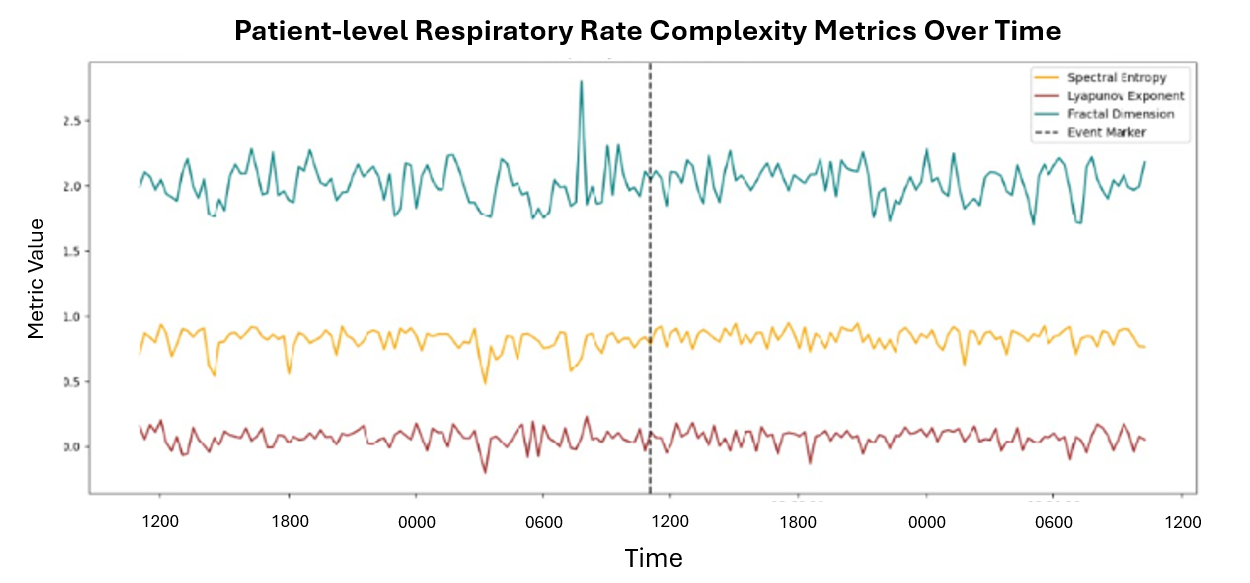 Mathematical representations of the time series data's complexity (Normalized Spectral Entropy), divergence (Rosenstein's Lyapunov Exponents), and self-similarity (Higuchi's Fractal Dimensions) were calculated and plotted for per-minute vital sign data. This example demonstrates these complexity metrics for a patient's respiratory rate in the 24 hours prior to and following an emergent intervention. Notably, this example demonstrates a sharp increase in one of the complexity metrics in the 3-4 hours prior to the emergent intervention, followed by a rapid return to baseline.
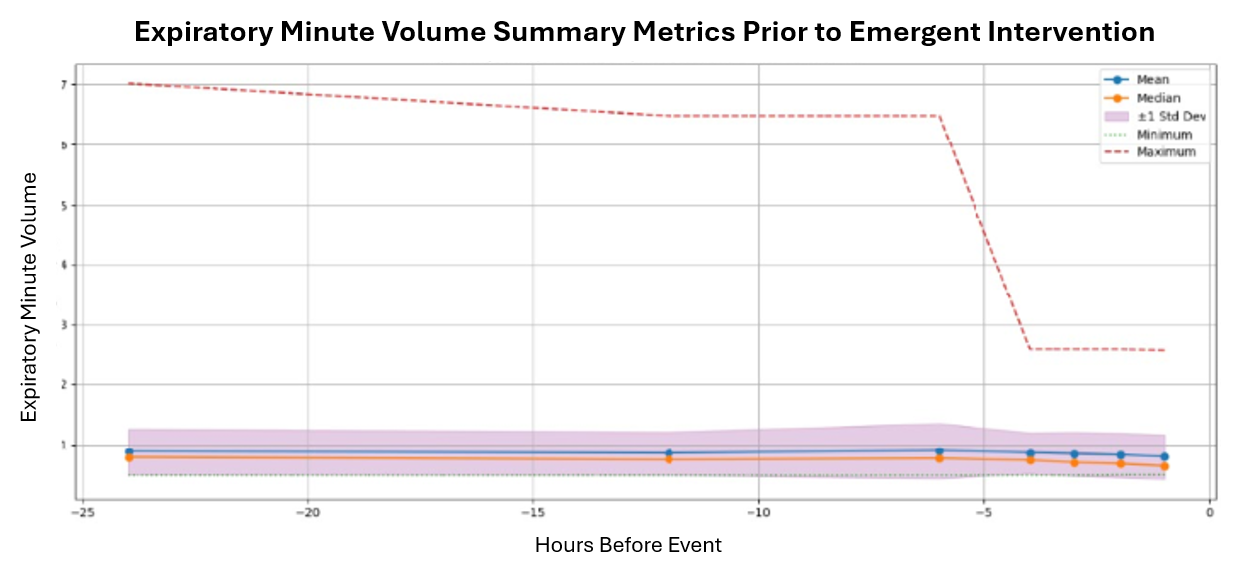 Mean, median, standard deviation, maximum, and minimum for per-minute vital sign and ventilator data were calculated for the 24, 12, 6, 4, 3, 2, and 1-hour periods prior to emergent intervention for each patient. This example demonstrates a dramatic decrease in the maximum expiratory minute volume in the 2-4 hour period prior to emergent intervention.