Session: Developmental and Behavioral Pediatrics 2: Autism/Other
103 - Factors Associated with Vaccine Hesitancy Among a Large Cohort of Parents of Children with Autism
Friday, April 24, 2026
5:30pm - 8:00pm ET
Publication Number: 1095.103
Michaela Brown, Texas Children's Hospital, Houston, TX, United States; Sarah S. Mire, Baylor University, Waco, TX, United States; Eric Fombonne, Oregon Health & Science University, Portland, OR, United States; Robin P. Goin-Kochel, Baylor College of Medicine, Houston, TX, United States
Psychology Fellow Texas Children's Hospital Houston, Texas, United States
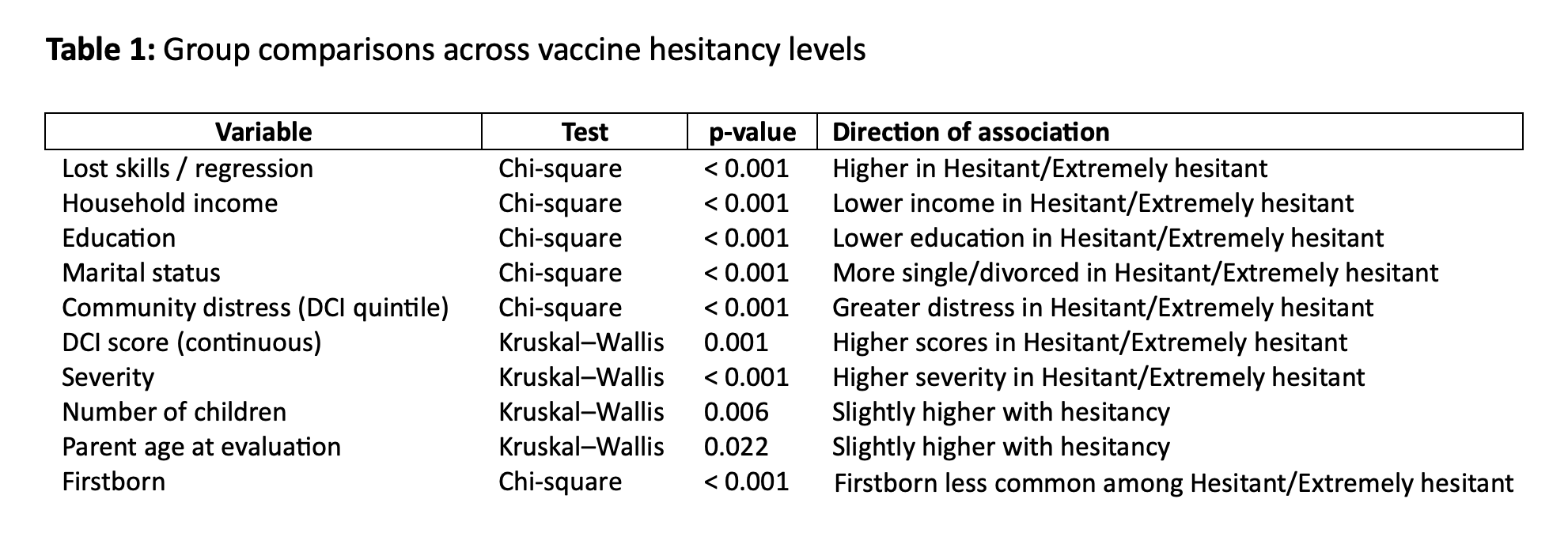
Background: Parental attitudes toward childhood vaccines are influenced by a variety of factors, including misinformation, lack of education, safety concerns, opinions/experiences of others, cultural values, and community influences (Ellithorpe et al., 2022; Kaushal, 2025; Richman et al., 2025). On top of this, a child's diagnosis of autism may further complicate parents' understanding and perceptions about vaccine safety because of both (a) the persistent misinformation about links between vaccines and autism and (b) parents beliefs/perceptions about autism. However, less is known about how various factors work in concert to predict vaccine hesitancy among families managing autism. Objective: To examine predictors of vaccine hesitancy among parents of children with autism with respect to child, family, and demographic factors; caregiver perspectives about autism and adjustment to the diagnosis; and community-distress level. Design/Methods: Participants were 8,401 caregivers of children with autism (mean age=11.94, % males = 80.4%) enrolled in the national SPARK study. Data were collected between April and June 2019 and included measures of vaccine hesitancy (Parent Attitudes About Childhood Vaccines; PACV); illness perceptions about autism (Illness Perception Questionnaire-Revised for Autism; IPQ-R) and adjustment to the autism diagnosis (Family Adjustment Measure; FAM). Participant zip code data were merged with the Distressed Communities Index (DCI) scores to yield a measure of community influence. Vaccine hesitancy status was categorized as not hesitant, hesitant, or extremely hesitant. Descriptive analyses using chi-square and Kruskal Wallis were computed, then one-way ANOVAS were conducted to assess group differences. Results: Household income, education, marital status and community distress quintile were significant predictors of hesitancy (p ≤ 0.001). One-way ANOVAS demonstrated significant group differences across hesitancy groups regarding family's adjustment and supports (p < .001) and the family perceptions of ASD, including the timing of the diagnosis (p <.001), control over treatment (p <.001), coherence (p < .001) and distress/negative emotions (p < .001).
Conclusion(s): Many factors were found to predict the degree of vaccine hesitancy in parents, including demographic factors, and one's perception of and adjustment to the diagnosis. Families in more distressed communities showed greater vaccine hesitancy and higher endorsement of autism-related causal beliefs. These results can help to create more effective parent psychoeducation. Implications for pediatricians and medical educators are discussed.
Table 1: Group comparisons across vaccine hesitancy levels