492 - Investigating Adolescent Awareness of Clinical Trials: A Call to AACTion
Monday, April 27, 2026
8:00am - 10:00am ET
Publication Number: 4483.492
Anna E. Burns, Children's Mercy Hospitals and Clinics, Leawood, KS, United States; Stephani Stancil, Children's Mercy Hospitals and Clinics, Kansas City, MO, United States; Mariah Brewe, Children's Mercy Hospitals and Clinics, Kansas City, MO, United States
Research Assistant Children's Mercy Hospitals and Clinics Leawood, Kansas, United States
Background: Representation in clinical trials (CT) is critical for health equity and CT participation should reflect the burden of disease. Most medications (80%) prescribed for adolescents are off-label and reflect lack of inclusion in pivotal clinical trials. Increasing CT awareness can foster future participation, yet knowledge regarding AYA CT awareness is limited to oncology. Objective: This study explore AYA's awareness and perceptions of CTs outside a disease specific context. Design/Methods: IRB-approved, qualitative study of AYA receiving outpatient care at a Midwestern pediatric academic medical center (Adolescent and Young Adult Medicine and Weight Management Clinics). Semi-structured interviews were conducted by study staff and guided by the following themes: 1) CT awareness, 2) perceived benefits/concerns and 3) future communication. AYA unaware or unsure of CTs were provided a standardized explanation and the interview continued. AYA self-reported demographics and electronic health records were reviewed for medical history. Interviews were coded by ≥2 investigators and the data examined with descriptive statistics. Results: 20 AYA with a variety of medical conditions were interviewed (Table 1). 60% of teens had never heard the phrase "clinical trial" or were unsure what it meant. Those familiar with the term associated it with research, testing treatments, or collecting data. When asked about CT benefits, AYA generally felt they could improve understanding of how medicines work, enhance treatment effectiveness, and help others by advancing care. When asked about concerns and considerations of CTs, AYA brought up examples about safety or side effects, fear of the unknown, and possible discomfort. Issues related to privacy and ethical considerations were mentioned, one teen stating "modern age people are protective of their information". AYA preferred to receive information on clinical trials through face-to-face communication from their doctor or research team. Others mentioned being open to hearing about opportunities via phone, email, patient portal, flyers, or peers with similar experiences.
Conclusion(s): Findings from these exploratory discussions suggest that many adolescents and young adults have limited awareness and understanding of clinical trials. Yet, perceptions were generally positive. AYA's curiosity about how treatments work with some addressable concerns highlight an opportunity for proactive education and engagement. Future work should explore strategies for increasing awareness and understanding of clinical trials, promoting health equity for AYA through access to emerging treatments.










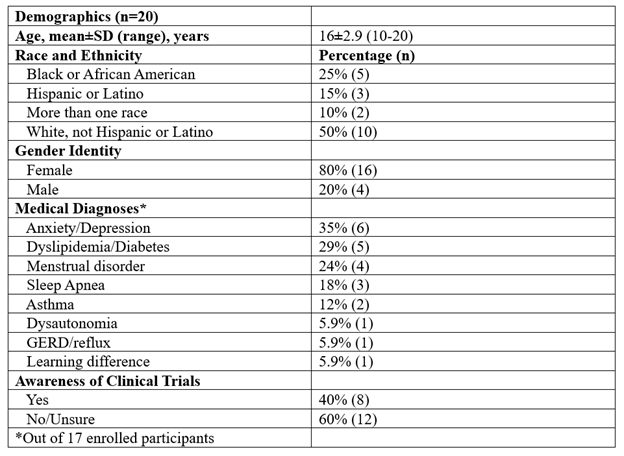 Participant demographics