Session: Developmental and Behavioral Pediatrics 1: Autism
84 - ECHO Autism: Intense Behavior – Building Capacity to Manage Challenging Behaviors in Autistic Youth
Friday, April 24, 2026
5:30pm - 8:00pm ET
Publication Number: 1076.84
Martine Lamy, Cincinnati Children's Hospital Medical Center, CINCINNATI, OH, United States; Katrina Boles, University of Missouri, ECHO Autism Communities, Colu, MO, United States; Matthew Siegel, Boston Children's Hospital, boston, MA, United States; Kristin Sohl, University of Missouri-Columbia School of Medicine, Columbia, MO, United States
Associate Professor Cincinnati Children's Hospital Medical Center CINCINNATI, Ohio, United States
Background: Youth with autism spectrum disorders often present with intense behaviors such as aggression, self-injury, and severe emotional dysregulation. Most pediatricians and subspecialists receive limited training in managing these behaviors. The Extension for Community Health Outcomes (ECHO) model offers a scalable approach to disseminate expert knowledge and build clinical capacity. ECHO Autism is one approach to improve capacity for treatment of autistic youth. Objective: To assess the feasibility, acceptability, appropriateness, and adoption of the ECHO Autism model for training physicians and nurse practitioners to better manage intense behaviors in autistic youth. We also analyzed case presentations for thematic patterns and evaluated participant satisfaction and self-efficacy. Design/Methods: ECHO Autism: Intense Behavior was a 20-session ECHO program designed for pediatricians, psychiatrists, neurologists, developmental-behavioral pediatricians, and psychiatric nurse practitioners. A multidisciplinary HUB team, including two child psychiatrists and pediatricians, a psychologist, a speech-language pathologist, and two parents with lived experience. Each session included case-based learning and brief didactics on interdisciplinary collaboration, co-occurring conditions, and psychopharmacology. Participants completed pre-, mid-, and post-program surveys assessing practice patterns, satisfaction, and self-efficacy. Wilcoxon signed-rank tests were used to analyze pre-post changes. Results: There were 163 unique learners; 52 attended more than 10 sessions. Eighty percent of participants were physicians (51% psychiatrists, 32% pediatric specialists, 3% neurologists, 14% pediatricians), and 13% were nurse practitioners. Thirty-six participants completed both pre- and post-surveys. Participants reported significantly increased self-efficacy on program-specific learning outcomes (p = 2.91E-11; α = 0.01), including assessment of medical, psychiatric, and environmental contributors, evidence-based psychopharmacology, and referral strategies. Eighty-nine percent reported positive changes in professional practice.
Conclusion(s): ECHO Autism: Intense Behavior effectively addressed a critical training gap and was overall well-received by participants. Most participants found value in the program, reported increased self-efficacy, changed their practice as a result, and learned best-practice solutions to apply for their autistic patients experiencing intense behaviors.
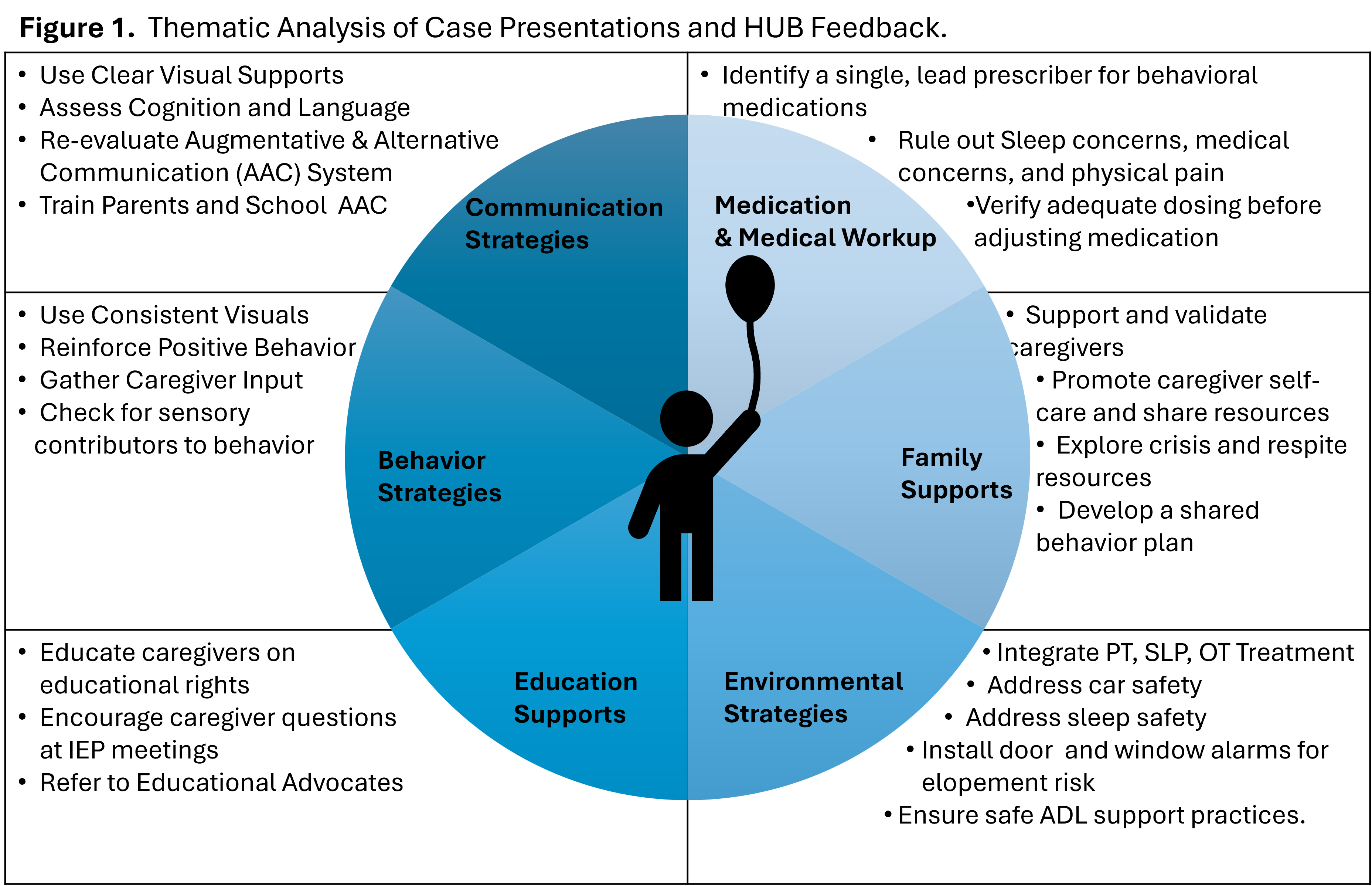
Thematic Analysis of ECHO Autism: Intense Behavior Case Presentations and HUB Recommendations
Case: A 15-year-old autistic boy with moderate intellectual disability presented with worsening intense behaviors. He has previously diagnoses of ADHD, intermittent explosive disorder and epilepsy (well-controlled), and treated with a stimulant medication, second generation antipsychotic, a benzodiazepine and two anti-epileptic drugs. He presented with worsening sleep and hour-long explosive outbursts with property destruction and aggression towards parents and teachers. He has eloped from the car twice in the last two months. He currently uses a communication device at school and needs 24/7 adult supervision for safety and ADLs. He receives no therapies or respite services outside of school, and has had several medication changes over the last several months to try to improve his irritability. There are no known new medical concerns, however he does not express pain or discomfort reliably.